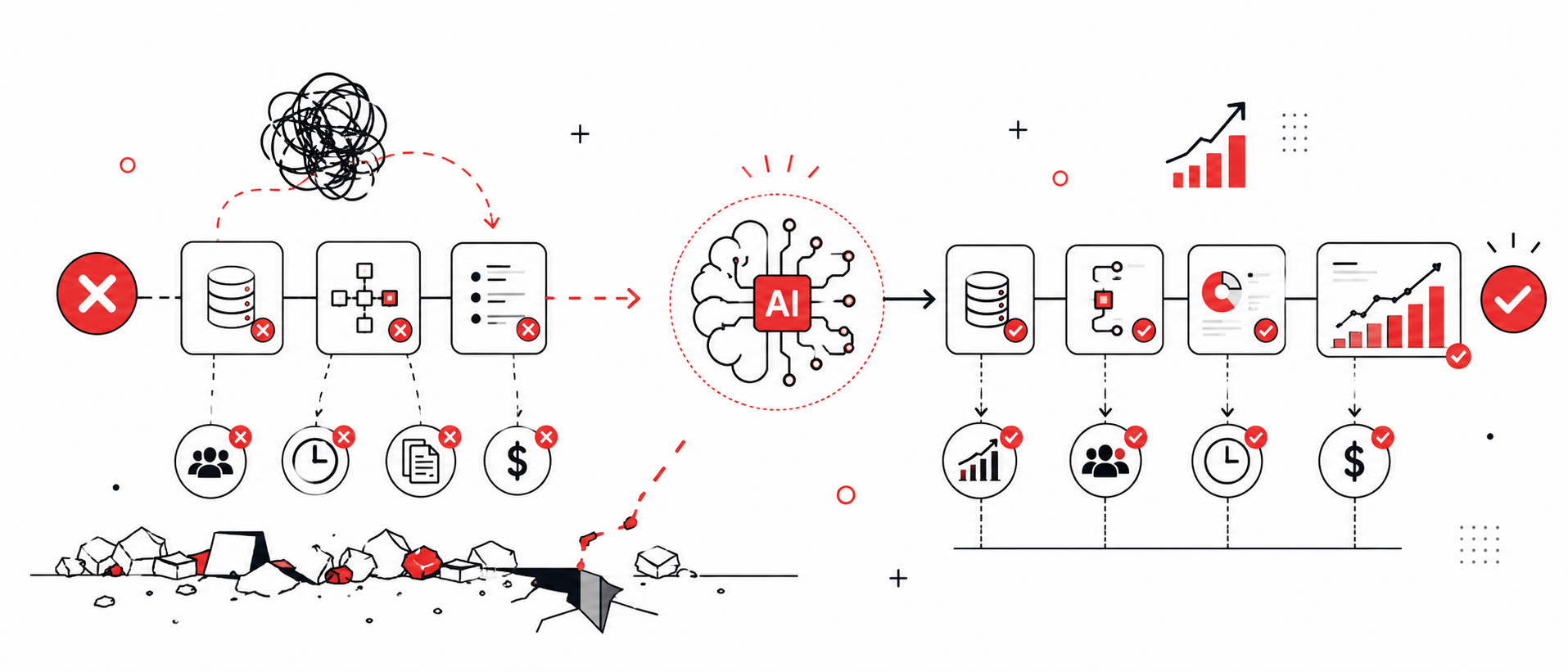
Why Most AI Projects Fail Before They Deliver Results
Artificial intelligence has become one of the most discussed business technologies of the decade.
Companies are investing billions of dollars into AI platforms, automation tools, copilots, and intelligent assistants. Every week seems to bring another breakthrough model, product launch, or success story.
Yet despite the excitement, many AI projects never deliver meaningful business value.
Some fail completely.
Others launch successfully but never achieve adoption.
Many simply become expensive experiments that generate little measurable impact.
The problem usually isn’t the technology.
The problem is how businesses approach implementation.
The AI Adoption Gap
Many organizations assume that adopting AI is primarily a technology challenge.
In reality, it’s often an operational challenge.
Businesses purchase tools before defining objectives.
They experiment with AI before understanding workflows.
They focus on capabilities instead of outcomes.
As a result, AI initiatives often begin with questions like:
- Which AI platform should we use?
- Which model is the most advanced?
- What new AI features are available?
The more important questions are often ignored:
- Which business problem are we solving?
- Which process needs improvement?
- Which metric should change?
- How will success be measured?
Without clear answers, AI projects struggle to create value.
Mistake #1: Starting With Technology Instead of Problems
One of the most common reasons AI projects fail is that organizations become excited about the technology itself.
Teams begin experimenting with tools before identifying a specific business challenge.
The result is often predictable.
Employees test AI.
Demonstrations look impressive.
Leadership becomes interested.
But months later, nobody can point to measurable improvements.
Successful AI initiatives work in reverse.
They begin with a problem.
For example:
- Lead qualification takes too long.
- Customer inquiries overwhelm support teams.
- Employees spend hours reviewing documents.
- Reporting requires excessive manual effort.
When AI is applied to a clearly defined challenge, value becomes much easier to measure.
Mistake #2: Ignoring Existing Workflows
Many organizations attempt to introduce AI without considering how work actually gets done.
The technology may be powerful, but if it doesn’t fit naturally into existing workflows, adoption suffers.
Employees don’t want additional systems to manage.
They want existing processes to become easier.
The most successful AI implementations are often invisible.
Instead of forcing employees to change how they work, AI enhances the systems already in place.
This is why AI integrated directly into CRM platforms, help desks, communication tools, and operational workflows often produces better results than standalone applications.
AI succeeds when it becomes part of the workflow.
Mistake #3: Expecting Immediate Transformation
AI is frequently marketed as a revolutionary technology capable of transforming entire organizations overnight.
This expectation creates problems.
Business leaders invest in ambitious projects expecting dramatic results.
When immediate transformation fails to materialize, confidence declines.
Resources are reduced.
Projects stall.
In reality, successful AI adoption usually happens gradually.
Organizations solve one problem.
Then another.
Then another.
Over time, these improvements compound into meaningful operational advantages.
The companies seeing the greatest returns from AI are rarely attempting complete transformation from day one.
They’re executing a series of focused improvements.
Mistake #4: Failing to Measure Success
Many AI initiatives launch without clear success criteria.
Teams know they want to “use AI,” but they don’t know how success will be evaluated.
Without measurement, it becomes difficult to determine whether the project is creating value.
Every AI initiative should be tied to a business outcome.
Examples include:
- Faster response times
- Reduced operational costs
- Higher conversion rates
- Improved customer satisfaction
- Increased employee productivity
- Faster document processing
If a business cannot identify the metric it wants to improve, it should reconsider the project before moving forward.
Mistake #5: Treating AI as a Standalone Tool
Many organizations view AI as a separate technology category.
They purchase an AI platform and expect it to generate value independently.
This approach rarely works.
The highest-impact AI systems are connected to:
- CRM platforms
- Customer data
- Internal documentation
- Business workflows
- Communication channels
- Operational processes
When AI has access to relevant information and can participate in business operations, its value increases dramatically.
AI becomes far more useful when it helps complete work rather than simply generating content.
Why CRM, Automation, and AI Work Better Together
One of the biggest lessons emerging from successful implementations is that AI rarely works alone.
The greatest business outcomes occur when AI is combined with automation and operational systems.
Consider a simple example:
A new lead enters the business.
A modern system can:
- Capture the lead automatically
- Enrich the contact information
- Score the opportunity
- Assign the lead
- Notify the appropriate team member
- Draft an initial response
- Schedule follow-up actions
This isn’t just AI.
It’s CRM, automation, and AI working together.
The business outcome is faster response times, improved customer experiences, and higher conversion rates.
That’s where real value is created.
The Companies Winning With AI
The businesses generating the strongest returns from AI share several characteristics.
They:
- Focus on business outcomes
- Automate repetitive processes
- Integrate AI into existing workflows
- Measure results consistently
- Start with practical use cases
Most importantly, they view AI as part of a larger operational strategy rather than a standalone solution.
Their goal isn’t simply to adopt AI.
Their goal is to build smarter systems.
The Future of AI Adoption
The next wave of AI adoption will look different from the first.
Businesses are moving beyond experimentation.
The focus is shifting from chatbots and demonstrations to operational efficiency, workflow automation, and measurable business outcomes.
Organizations that successfully combine CRM systems, automation platforms, and AI capabilities will be positioned to operate faster, scale more efficiently, and deliver better customer experiences.
The technology will continue to improve.
The challenge will be implementation.
Key Takeaway
Most AI projects fail because businesses focus on the technology instead of the business problem.
Successful AI adoption begins with a workflow, a challenge, or a measurable objective.
The companies seeing the greatest results are not asking:
“What can AI do?”
They’re asking:
“Which process should we improve?”
That shift in thinking often determines whether an AI initiative becomes a competitive advantage or an expensive experiment.
Ready to Build AI That Delivers Results?
Global Tech Signal helps businesses identify high-impact automation opportunities, design custom CRM systems, and implement AI solutions that improve operational efficiency and support growth.
If you’re evaluating AI adoption and want a practical roadmap focused on measurable business outcomes, our team can help identify where AI can create the greatest impact within your organization.

