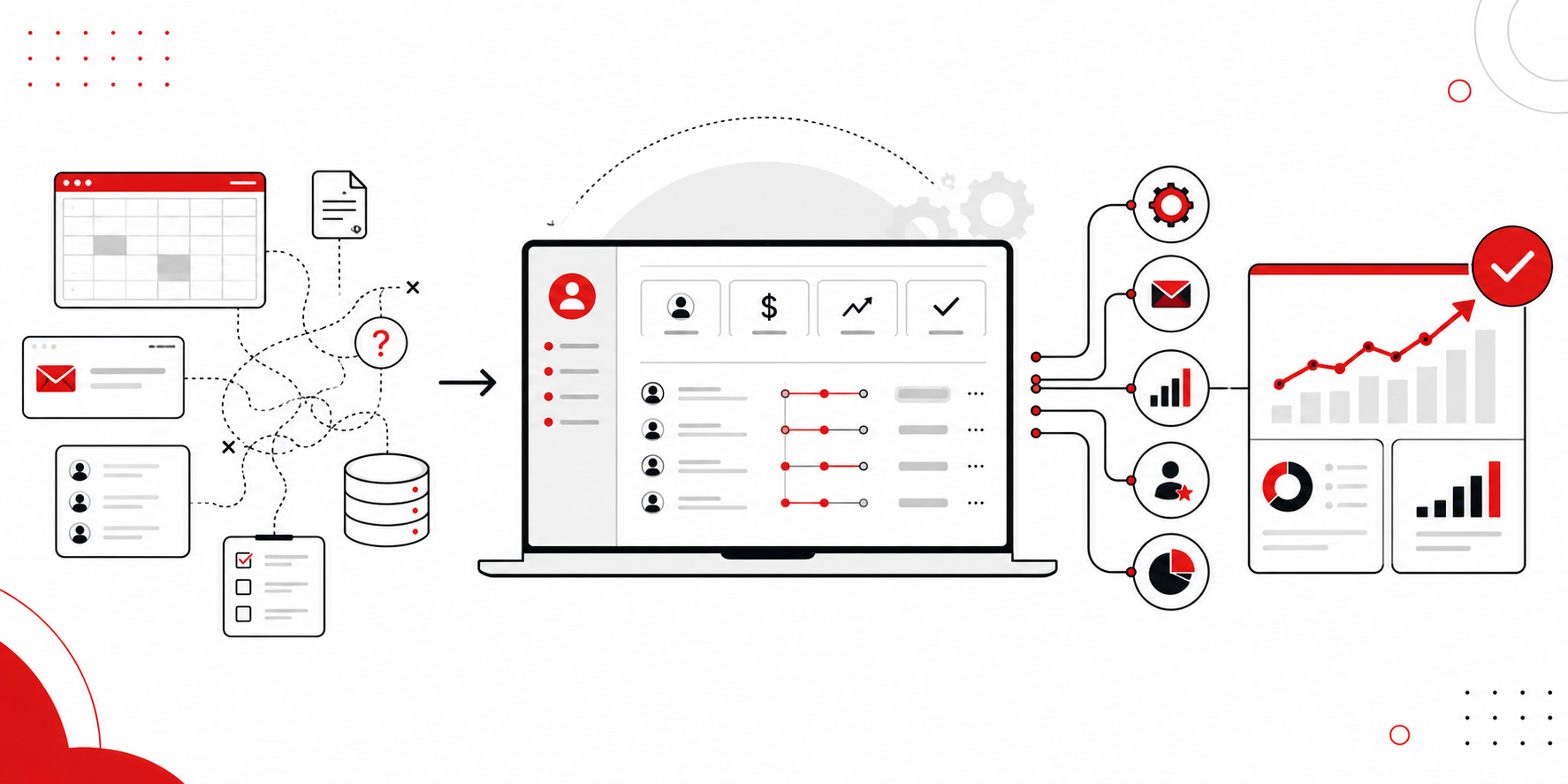
Why CRM Implementations Fail (And How to Avoid It)
For many growing businesses, implementing a Customer Relationship Management (CRM) platform feels like the logical next step. Sales teams need better visibility, customer information is scattered across spreadsheets, and leadership wants accurate forecasting.
The expectation is simple: implement a CRM, and operations become more efficient.
Unfortunately, that’s rarely what happens.
Many CRM implementations fail to deliver the expected business value—not because the software lacks capabilities, but because organizations approach implementation as a technology project instead of a business transformation initiative.
At Global Tech Signal, we believe technology should support well-designed business operations, not compensate for broken processes. A successful CRM implementation begins long before selecting a platform.
CRM Doesn’t Fix Broken Processes
One of the biggest misconceptions is that a CRM will automatically improve sales performance and customer management.
It won’t.
A CRM simply provides structure to the processes that already exist.
If lead qualification is inconsistent, customer information is incomplete, or sales teams follow different workflows, implementing a CRM simply digitizes those problems.
Before introducing any technology, businesses should understand how opportunities move through their organization, where bottlenecks occur, and what information teams actually need to do their jobs effectively.
Technology should reinforce efficient operations—not create them.
Mistake #1: Choosing Software Before Understanding the Business
Many CRM projects begin with product demonstrations and feature comparisons.
Questions like:
- Which CRM has the best automation?
- Which platform integrates with our tools?
- Which vendor offers the lowest price?
While these questions matter, they’re not the most important ones.
Businesses should first ask:
- How do we currently manage leads?
- Where do opportunities get delayed?
- Which manual processes slow our teams down?
- What information is missing when decisions are made?
Only after understanding these operational challenges should technology enter the conversation.
Mistake #2: Treating CRM as a Contact Database
Modern CRM platforms are far more than digital address books.
They manage the entire customer lifecycle—from lead generation and qualification to sales, onboarding, customer success, and long-term relationships.
Businesses that only store customer information inside their CRM often use a fraction of its capabilities.
A well-designed CRM should help organizations:
- Standardize sales processes
- Improve pipeline visibility
- Automate repetitive tasks
- Strengthen customer communication
- Generate meaningful business insights
- Improve forecasting accuracy
The value comes from improving operations—not simply storing data.
Mistake #3: Poor Data Quality
A CRM quickly loses value when the information inside it cannot be trusted.
Duplicate contacts.
Missing customer details.
Inconsistent naming conventions.
Outdated opportunities.
Once employees stop trusting the data, they begin maintaining their own spreadsheets and notes, creating multiple versions of the truth.
Successful CRM implementations establish clear standards for data quality from the beginning, including ownership, validation rules, required fields, and ongoing governance.
Mistake #4: Ignoring User Adoption
Many CRM projects focus heavily on technical implementation while overlooking the people who use the system every day.
Employees often resist CRM platforms because they feel like additional administrative work rather than tools that simplify their jobs.
Successful implementations prioritize usability.
Sales representatives should spend less time entering information.
Managers should gain better visibility.
Leadership should receive accurate reporting without requesting manual updates.
When employees clearly see personal value, adoption follows naturally.
Mistake #5: Automating Inefficient Workflows
Automation is one of the strongest capabilities of a modern CRM.
However, automating an inefficient process simply allows inefficiency to happen faster.
Before creating workflows, organizations should evaluate whether the underlying process actually makes sense.
Questions worth asking include:
- Can unnecessary approvals be removed?
- Are duplicate tasks being performed by multiple teams?
- Is customer information being collected more than once?
- Can manual handoffs be eliminated?
Simplifying operations before automation produces significantly better outcomes.
Mistake #6: No Executive Ownership
CRM projects often become IT initiatives.
In reality, they affect sales, marketing, customer service, finance, and leadership.
Without executive sponsorship, departments create conflicting priorities, adoption declines, and process improvements stall.
Successful CRM implementations require leadership alignment because the objective isn’t software deployment—it’s improving how the business operates.
CRM Should Evolve With the Business
Launching a CRM isn’t the finish line.
As organizations grow, new operational challenges emerge.
Reporting requirements change.
Teams expand.
Customer expectations evolve.
Automation opportunities increase.
The most successful businesses continuously optimize their CRM by refining workflows, improving dashboards, introducing new automations, and measuring operational performance.
A CRM should grow alongside the business—not remain unchanged after implementation.
Final Thoughts
CRM implementations rarely fail because businesses selected the wrong platform.
They fail because organizations expect software to solve operational challenges that were never fully understood.
Businesses that achieve the greatest return from CRM begin by examining how they operate, identifying bottlenecks, and standardizing processes before introducing technology.
When CRM is implemented as part of a broader operational strategy, it becomes far more than a customer database.
It becomes the foundation for stronger customer relationships, better decision-making, improved collaboration, and sustainable business growth.

