What CEOs Miss When Scaling Operations
Growing a business is exciting. New customers arrive, revenue increases, and teams expand to support demand. For many CEOs, these are clear signs that the company is moving in the right direction.
Yet growth often brings an unexpected challenge.
The very processes that helped the business reach its current stage begin to struggle under increased complexity. Communication becomes fragmented, decisions take longer, and leaders find themselves spending more time solving operational issues than driving strategic initiatives.
Scaling isn’t simply about growing revenue—it’s about ensuring the business can continue to operate efficiently as it grows.
Growth Reveals Operational Weaknesses
A business with ten employees can often rely on informal communication and manual processes.
Everyone understands how work gets done. Customer information is easy to find. Problems are solved through quick conversations.
As organizations grow, this approach no longer scales.
Departments begin working independently. Teams adopt different processes. Critical information becomes scattered across spreadsheets, emails, chat applications, and disconnected software platforms.
Growth doesn’t create operational problems—it exposes the ones that already existed.
More Technology Isn’t Always the Answer
When operational challenges appear, many businesses respond by purchasing another software platform.
A new CRM promises better sales visibility.
A project management platform promises improved collaboration.
An AI assistant promises greater productivity.
While each of these tools can provide value, none of them solve poorly designed business processes.
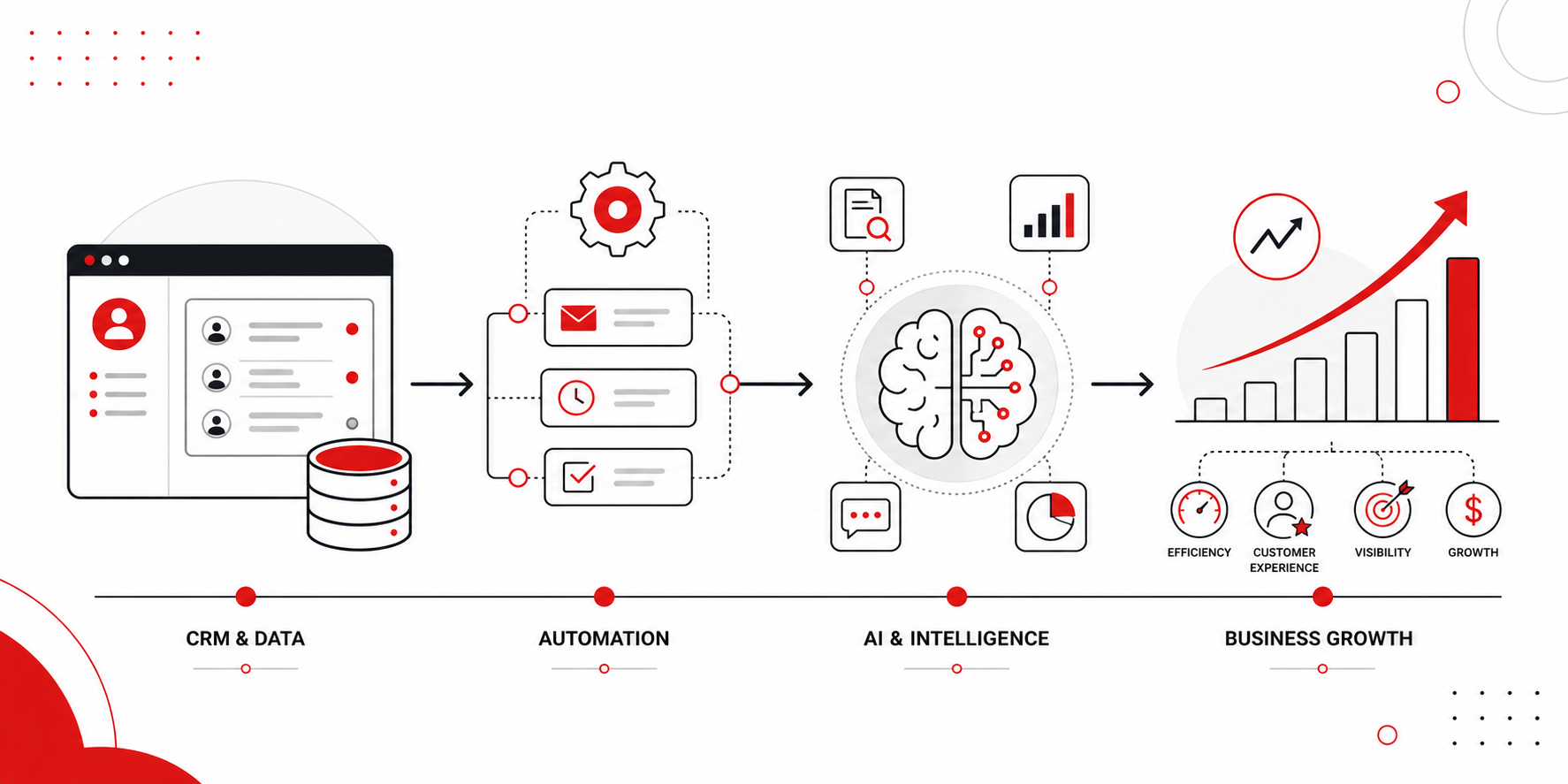
Technology accelerates existing workflows. If those workflows are inefficient, disconnected, or inconsistent, adding more technology often increases complexity rather than reducing it.
The most successful organizations begin by understanding how work flows through the business before deciding which technology should support it.
Visibility Becomes More Important Than Activity
One of the biggest changes CEOs experience during growth is reduced visibility.
In smaller businesses, leaders often have direct insight into sales, operations, customer service, and project delivery.
As the company expands, that visibility disappears.
Without reliable reporting and standardized processes, important questions become difficult to answer.
- Where are deals getting stuck?
- Which processes consume the most employee time?
- Why are customers waiting longer for responses?
- Which teams are overloaded?
- What operational issues are limiting growth?
Businesses that establish operational dashboards, clear KPIs, and standardized reporting can identify issues before they become major obstacles.
Sustainable Growth Depends on Systems
Growing businesses frequently depend on individuals rather than documented systems.
One employee knows how onboarding works.
Another understands every client relationship.
Someone else remembers how reports are created each month.
While experienced employees are valuable, organizations that rely on individual knowledge become increasingly difficult to scale.
Successful businesses build repeatable systems instead.
Documented workflows, standardized operating procedures, automation, and clearly defined responsibilities allow teams to deliver consistent results regardless of company size.
Systems make growth predictable.
AI Works Best When Operations Are Healthy
Artificial intelligence is transforming how businesses operate.
From customer support to document processing and workflow automation, AI has enormous potential to improve productivity.
However, AI cannot compensate for disorganized operations.
If customer data is incomplete, workflows are inconsistent, or processes vary between departments, AI simply amplifies those inefficiencies.
Organizations achieve the greatest return from AI after establishing clear processes, reliable data, and operational visibility.
AI should enhance good operations—not replace them.
The CEOs Who Scale Successfully Think Differently
Leaders who build resilient businesses focus less on acquiring more technology and more on improving how their organizations operate.
They continuously ask questions such as:
- Which processes create unnecessary friction?
- Where are manual tasks slowing the business down?
- Which systems no longer support our growth?
- What information do our teams need to make better decisions?
- How can technology simplify operations instead of adding complexity?
These questions lead to better decisions, stronger operational foundations, and more sustainable growth.
Final Thoughts
Scaling a business isn’t simply about hiring more people or investing in more software.
It requires building an operational foundation that allows the organization to grow without creating unnecessary complexity.
The businesses that scale successfully are not always the ones with the largest technology budgets.
They are the ones that continuously improve their operations, strengthen their systems, and adopt technology where it delivers measurable business value.
Operational excellence is not a one-time initiative. It is an ongoing investment that enables businesses to grow with confidence.

