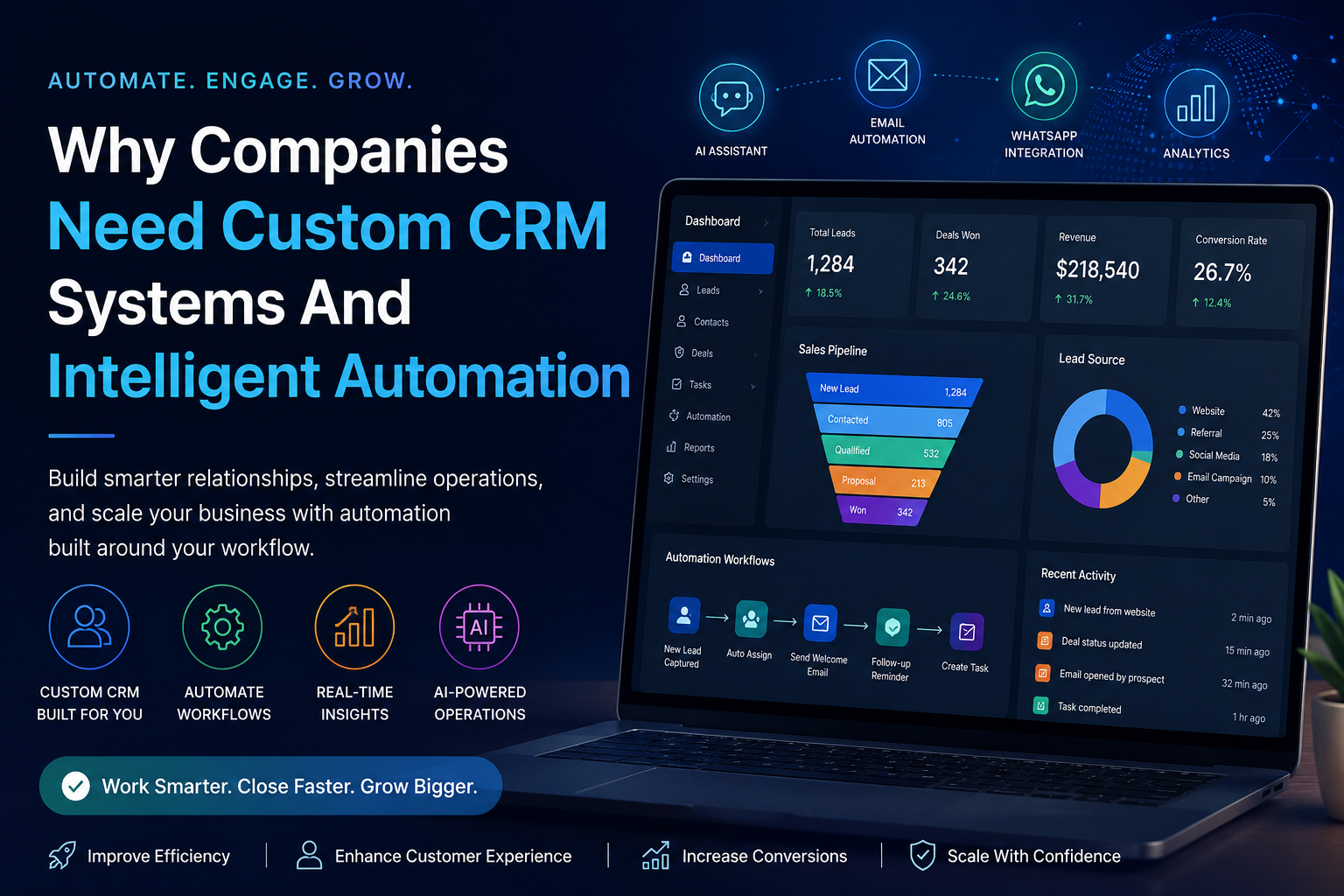
In today’s business environment, customer relationships move fast. Leads come from websites, social media, WhatsApp, ads, emails, referrals, and countless other channels. Teams work remotely, customers expect instant responses, and management needs real-time visibility into operations.
Yet many companies still rely on spreadsheets, disconnected tools, or generic off-the-shelf CRMs that were never designed for their actual workflow. This creates one of the biggest hidden problems in business today: companies are adapting their processes to software instead of building software around their processes. That is exactly why businesses are increasingly shifting toward custom-built CRM systems with intelligent automation.
1. What is a custom CRM?
A custom CRM (Customer Relationship Management system) is software designed specifically around your company’s workflow, operations, customers, sales process, and internal structure. Unlike generic CRMs, it is not overloaded with unnecessary features or constrained by rigid workflows. It is built for your sales process, your customer journey, your approval flows, and your reporting structure. A real CRM should feel like it was made for your company — because it actually was.
2. The problem with generic CRMs
Most SaaS CRMs are built for mass markets, trying to serve real estate firms, healthcare providers, eCommerce brands, agencies, SaaS businesses, and hundreds of other industries simultaneously. The result is bloated dashboards and confusing workflows where teams often use only 20–30% of the platform.
Generic CRMs also force companies to adjust their operations to match the software rather than the other way around — reducing productivity and creating friction across teams. As companies grow, per-user, per-automation, and per-integration pricing scales aggressively. A custom CRM becomes a long-term investment instead of an endless recurring expense.
Integration is another persistent challenge. Businesses today use multiple tools — email systems, WhatsApp APIs, ERPs, accounting software, and marketing platforms. Connecting them all through a generic CRM often becomes complex, unreliable, and expensive. A custom CRM integrates everything directly into one centralized ecosystem.
3. Why automation is critical
A CRM without automation is simply a digital notebook. Modern businesses require systems that actively work for them — eliminating repetitive tasks, reducing human error, improving customer experience, and increasing operational speed.
- Lead management — Automatically capture leads, assign them to sales reps, score quality, send instant responses, and schedule follow-ups so no lead gets lost.
- Sales pipelines — Move deals between stages, notify teams, generate invoices, trigger onboarding workflows, and create tasks without manual coordination.
- AI-powered support — Integrate AI agents that answer customer queries, route tickets, schedule meetings, and deliver 24/7 support without increasing headcount.
- Reporting & analytics — Generate sales reports, team performance metrics, revenue insights, and conversion analytics in real time, without manual effort.
- Communication — Automatically send emails, WhatsApp messages, SMS alerts, and reminders so communication stays seamless and consistent.
4. The competitive advantage
Companies using customized and automated systems operate faster because teams spend less time on repetitive work. Customers receive quicker, more consistent communication. Automated follow-ups reduce missed opportunities. Real-time analytics improve strategic decision-making. And as the business grows, the system grows with it — without the scaling costs of SaaS subscriptions.
5. The future is AI-integrated CRM
The future of CRM is not just data storage — it is intelligent business operations. Modern systems are integrating AI voice agents, AI chat, predictive analytics, automated workflows, and intelligent reporting. Businesses that adopt AI-enabled CRMs early gain a significant operational edge over competitors still running manual processes.
A poorly designed system creates workflow inefficiencies, employee frustration, data inconsistencies, and scalability problems. That is why companies need experienced engineering teams with expertise in business workflows, automation architecture, cloud infrastructure, security, AI integration, and UX design.
Final thoughts
Manual processes slow growth. Disconnected tools create chaos. Generic CRMs create limitations. Custom-built automated CRM systems give companies full control, better efficiency, improved scalability, smarter operations, and a genuine competitive advantage.
The future belongs to businesses that automate intelligently. Companies that invest in tailored CRM infrastructure today will outperform those still relying on spreadsheets and rigid third-party systems tomorrow. If your business is serious about scaling operations and improving customer management, working with an experienced development partner like Global Tech Signal can be a major strategic advantage.

