5 Signs Your CRM Is Slowing Down Your Business
Most businesses invest in a CRM expecting better organization, improved sales performance, and greater operational efficiency.
Yet many companies end up with the opposite experience.
Instead of helping teams move faster, the CRM becomes another system employees are forced to maintain. Data becomes outdated, workflows become fragmented, and important opportunities slip through the cracks.
The problem isn’t always the CRM itself.
More often, it’s a sign that the system no longer aligns with how the business actually operates.
If your CRM is creating friction instead of reducing it, it may be slowing down your growth.
Here are five signs to watch for.
1. Your Team Is Still Managing Processes Outside the CRM
A CRM should act as the central source of truth for customer information and business activity.
If employees are constantly relying on:
- Spreadsheets
- Sticky notes
- WhatsApp messages
- Email folders
- Separate tracking documents
then your CRM is likely failing to support critical workflows.
This often happens when the system is too rigid, lacks necessary features, or doesn’t match how teams actually work.
The result is fragmented information, duplicated effort, and reduced visibility across the business.
A healthy CRM should reduce the need for external tracking systems—not create them.
2. Lead Follow-Ups Depend on Memory
One of the most expensive problems in sales is inconsistent follow-up.
If sales representatives need to remember:
- Who to call
- When to follow up
- Which proposal was sent
- Which lead requested more information
then opportunities are being lost every day.
Modern CRM systems should automatically:
- Create follow-up tasks
- Trigger reminders
- Track communication history
- Notify teams when action is required
A business should never depend on memory to manage revenue-generating activities.
The more automated the process becomes, the more consistent the results.
3. It Takes Too Long to Respond to New Leads
Speed-to-lead is one of the most important metrics in modern sales.
When a prospect submits an inquiry, response time directly impacts conversion rates.
Yet many businesses still rely on manual processes:
- Someone checks a form submission
- Someone reviews the lead
- Someone assigns the opportunity
- Someone eventually follows up
This creates delays that can cost significant revenue.
A modern CRM should automatically:
- Capture leads
- Assign them to the right person
- Notify the appropriate team member
- Trigger immediate responses
The businesses winning today are often the businesses responding first.
4. Reporting Requires Manual Work
If managers need to spend hours building reports every week, something is wrong.
A CRM should provide visibility into:
- Pipeline value
- Lead sources
- Conversion rates
- Sales performance
- Customer activity
without requiring constant spreadsheet exports and manual calculations.
When reporting becomes difficult, decision-making becomes slower.
Businesses lose the ability to identify bottlenecks, forecast accurately, and optimize performance.
Good reporting should happen automatically.
5. Your CRM Doesn’t Support Automation
Many businesses use CRM platforms that function primarily as digital filing cabinets.
Information goes in.
Employees retrieve information later.
Very little happens in between.
Modern businesses require much more.
Today’s CRM systems should support:
- Lead routing
- Task creation
- Follow-up sequences
- Customer notifications
- Workflow automation
- AI-powered assistance
If your CRM stores data but doesn’t actively help your team execute work, it may be limiting growth rather than enabling it.
The future of CRM isn’t just data management.
It’s operational automation.
Why This Matters More Than Ever
Customer expectations continue to increase.
Leads expect immediate responses.
Customers expect personalized experiences.
Teams need access to information faster than ever before.
Businesses that rely on manual processes struggle to keep pace.
The companies gaining the greatest advantage today aren’t necessarily generating more leads or hiring more people.
They’re building systems that eliminate friction and allow teams to focus on high-value work.
The Shift From CRM Software to Business Operating Systems
The role of CRM is changing.
Historically, CRM systems were designed to organize customer data.
Today, businesses need systems that can:
- Manage workflows
- Automate repetitive tasks
- Coordinate teams
- Improve customer experiences
- Support AI-powered processes
The most effective CRM platforms are no longer databases.
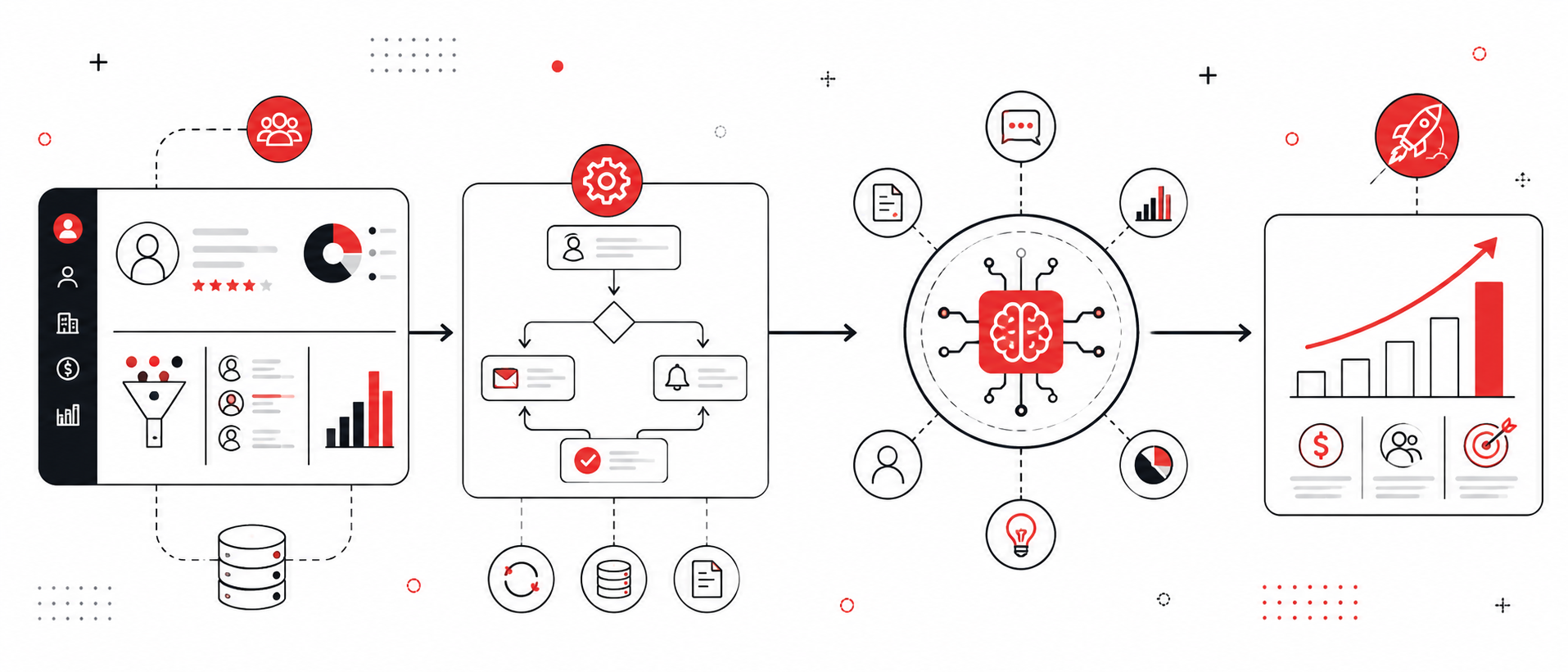
They are becoming operational hubs that connect people, processes, automation, and customer information.
Key Takeaway
If your team is relying on spreadsheets, missing follow-ups, responding slowly to leads, manually creating reports, or working around your CRM, the system may be slowing your business down.
A CRM should make operations simpler, faster, and more efficient.
If it doesn’t, it may be time to rethink the technology supporting your growth.
Ready to Build a CRM That Fits Your Business?
Global Tech Signal helps businesses design and develop custom CRM systems that align with their workflows, automate repetitive tasks, and support long-term growth.
Whether you’re struggling with an existing CRM or evaluating a custom solution, our team can help identify opportunities to improve efficiency, visibility, and customer experience through smarter systems.

